Go East!
- Report of a Botanical Journey in Bjelašnica
- Report of a Botanical Journey in Sutjeska National Park
- A list of all recorded species in Bjelašnica
- A list of all recorded species in Sutjeska National Park
Report of this BotanicalJourney
 To
get the nasty things done with first, I have to say something
about the mine risk in the country. Only a small percentage of
Bosnia and Herzegovina is contaminated with mines. Unfortunately
this area covers the Botanically most interesting parts like high
mountains (for example Prenj and Treskavica) and river beds like
the Neretva. There are maps available that indicate the areas with
a high mine risk, but these maps are inaccurate and hard to find.
A useful publication however is the book Forgotten Beauty by
Matias Gomez, published by Buybook (a publishing company annex
book shop in Sarajevo). The book is not easy to buy, but with a
little effort you can still find it on the internet and at
Buybook. Mr. Gomez has climbed all the peaks of over 2,000 meters
in Bosnia and Herzegovina and describes the paths he followed and
the best way to navigate along them. He has added maps with mine
risks as well. We found the book to be invaluable during our
BotanicalJourney because it contained detailed maps of the areas
we walked and warned us for mine-contaminated areas where we had
to be careful. If you go on a BotanicalJourney in such an area,
use your common sense and do NOT step aside of the paths.
Fortunately there are many mine-free areas in Bosnia and
Herzegovina that are definitely worth visiting. One of them is
Sutjeska which I will describe below.
To
get the nasty things done with first, I have to say something
about the mine risk in the country. Only a small percentage of
Bosnia and Herzegovina is contaminated with mines. Unfortunately
this area covers the Botanically most interesting parts like high
mountains (for example Prenj and Treskavica) and river beds like
the Neretva. There are maps available that indicate the areas with
a high mine risk, but these maps are inaccurate and hard to find.
A useful publication however is the book Forgotten Beauty by
Matias Gomez, published by Buybook (a publishing company annex
book shop in Sarajevo). The book is not easy to buy, but with a
little effort you can still find it on the internet and at
Buybook. Mr. Gomez has climbed all the peaks of over 2,000 meters
in Bosnia and Herzegovina and describes the paths he followed and
the best way to navigate along them. He has added maps with mine
risks as well. We found the book to be invaluable during our
BotanicalJourney because it contained detailed maps of the areas
we walked and warned us for mine-contaminated areas where we had
to be careful. If you go on a BotanicalJourney in such an area,
use your common sense and do NOT step aside of the paths.
Fortunately there are many mine-free areas in Bosnia and
Herzegovina that are definitely worth visiting. One of them is
Sutjeska which I will describe below.
After you have managed to find the book Forgotten Beauty and/or managed to find recent maps which can help you preparing your BotanicalJourney, the next problem to overcome is how to find a flora that is useful. There are some publications on the wild plants of Bosnia and Herzegovina, but they are outdated, written in an incomprehensible language, or just very incomplete. For identification of species I combined lots of different floras. By taking large numbers of pictures I was able to identify some species when I returned home. My BotanicalJourneys were restricted to mountain areas, which narrowed down the number of possible plant species a bit. I recommend using the following publications (some of which I found with the generous help of a nice lady from the department of Botany of the Museum for Natural History in Sarajevo):
- P. Fukarek: 'Zajednica klekovine bora (Pinetum mughi Horvat) i neke razvojne tendencije na bosansko-hercegovackim planinama (Plant community of Mugho Pine (Pinetum mughi Horvat) and some developmental tendencies of its successions in the mountains of Bosnia and Herzegovina)', Glasilo Sumarskog Drustva Nr Hrvatske, No. 11-12, November-December 1956, pp 343-357.
- R. Lakusić et. al: 'Planinska vegetacija Maglica, Volujaka i Zelengore (The mountain vegetation of the Maglic, Volujak and Zelengora area)', Posebna izdanja XI, Akademija nauka i umjetnosti Bosne i Hercegovine, Odjeljenje prirodnih i matematickih nauka, Sarajevo, 1969, pp 171-188.
- Z. Bjelcic: 'Prilog poznavanju flore nekih bosanskih i crnogorski planina (Contribution to the knowledge of the flora of some Bosnian and Montenegrin mountains)', Godisnjak bioloskog instituta u Sarajevu, Godina IX, sveska 1-2, Sarajevo 1956, pp 141-152.
- C. Silic and S. Abadzic: 'Endemic plant species in the ecosystems of the mountains around the river Sutjeska', Godisnjak bioloskog instituta u Sarajevu, Volume 39, Sarajevo 1986, pp 151-160.
 The final problem you have to solve is the one that deals with
transportation. Traveling by car is the easiest way to get around
in Bosnia and Herzegovina, but there is a regular bus service from
the larger towns to most of the villages as well. You cannot
really plan anything in advance and even when you are at the bus
station in large cities, it is virtually impossible to find out
which service is going where. My advice is: don't hesitate and
just take any bus that goes in the direction you want to go. There
is always a connecting bus service, even if nobody can tell you
exactly when and where. People are very friendly and willing to
help you, and in my case I always got to the places I wanted to
go.
The final problem you have to solve is the one that deals with
transportation. Traveling by car is the easiest way to get around
in Bosnia and Herzegovina, but there is a regular bus service from
the larger towns to most of the villages as well. You cannot
really plan anything in advance and even when you are at the bus
station in large cities, it is virtually impossible to find out
which service is going where. My advice is: don't hesitate and
just take any bus that goes in the direction you want to go. There
is always a connecting bus service, even if nobody can tell you
exactly when and where. People are very friendly and willing to
help you, and in my case I always got to the places I wanted to
go.
BotanicalJourney in Bjelašnica (Google Map)
 The first part of the BotanicalJourney is in the Bjelašnica
mountain range, southwest of Sarajevo. The tallest peak in this
mountain range has an elevation of just over 2,000 meters. The
Winter Olympics of 1984 were organized in Sarajevo and the men's
alpine skiing events took place on Bjelašnica. There are still
hotels and skiing facilities dating from that time. They can be
reached by car. We wanted to cross Bjelašnica by foot and walk all
the way to the town of Konjic, so we asked a taxi driver to bring
us to hotel Marsal, at an altitude of about 1,300 meter. The staff
of Oaza camp in Sarajevo (which I can recommend as a camp site!)
negotiated a reasonable price for us. Should you choose to walk
from Sarajevo, please be aware that you cross some mine fields
while ascending the hills. They are marked, but be careful
nonetheless. Once you reach a certain height there is no mine risk
according to the maps.
The first part of the BotanicalJourney is in the Bjelašnica
mountain range, southwest of Sarajevo. The tallest peak in this
mountain range has an elevation of just over 2,000 meters. The
Winter Olympics of 1984 were organized in Sarajevo and the men's
alpine skiing events took place on Bjelašnica. There are still
hotels and skiing facilities dating from that time. They can be
reached by car. We wanted to cross Bjelašnica by foot and walk all
the way to the town of Konjic, so we asked a taxi driver to bring
us to hotel Marsal, at an altitude of about 1,300 meter. The staff
of Oaza camp in Sarajevo (which I can recommend as a camp site!)
negotiated a reasonable price for us. Should you choose to walk
from Sarajevo, please be aware that you cross some mine fields
while ascending the hills. They are marked, but be careful
nonetheless. Once you reach a certain height there is no mine risk
according to the maps.
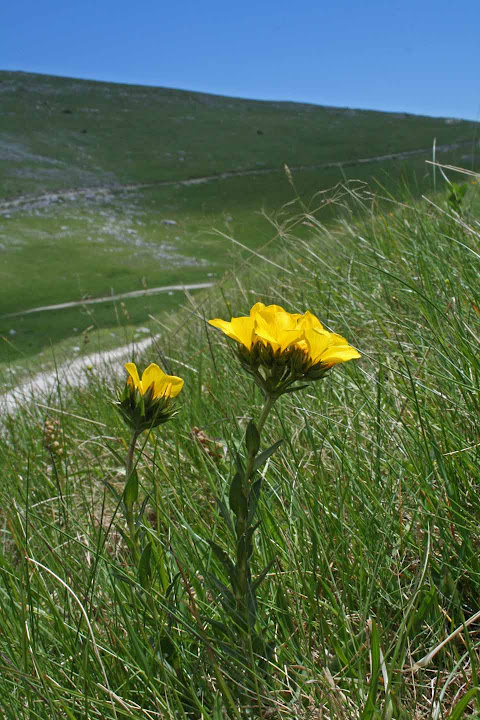 From hotel Marsal a narrow asphalt road continued to go up hill.
At first we passed many skiing facilities which were not
particularly nice to look at, but soon the road changed to an
unpaved path running along the edge of a forest with Gentiana
asclepiadea and Symphytum tuberosum next to the
road. At an altitude of about 1,500 meters the last trees were
vanished and we found ourselves in a rocky and grassy environment.
It was possible to walk all the way up to the summit of Bjelašnica
(2,067 meters), but we chose to follow the road westwards instead.
During the sometimes steep ascend we found many alpine and
subalpine plant species. Most abundant was without any doubt Linum
capitatum (see picture). The combination of its bright
yellow color together with the heavenly blue of Gentiana
utriculosa in overwhelming quantities was somewhat surreal.
Between the rocks we found some specimens of Viola biflora.
From hotel Marsal a narrow asphalt road continued to go up hill.
At first we passed many skiing facilities which were not
particularly nice to look at, but soon the road changed to an
unpaved path running along the edge of a forest with Gentiana
asclepiadea and Symphytum tuberosum next to the
road. At an altitude of about 1,500 meters the last trees were
vanished and we found ourselves in a rocky and grassy environment.
It was possible to walk all the way up to the summit of Bjelašnica
(2,067 meters), but we chose to follow the road westwards instead.
During the sometimes steep ascend we found many alpine and
subalpine plant species. Most abundant was without any doubt Linum
capitatum (see picture). The combination of its bright
yellow color together with the heavenly blue of Gentiana
utriculosa in overwhelming quantities was somewhat surreal.
Between the rocks we found some specimens of Viola biflora.
 After a while, we passed a
mountain saddle and entered the Dugo Polje, a large plateau
surrounded by high rocky cliffs. The rocks were rich in limestone
with many dolines in which found Veratrum album and
here and there Coeloglossum viride. There were one or two
plants of Hyoscyamus niger as well. On the bottom of the
valley I recorded many Helleborus species, which I
believed to be Helleborus dumetorum. Between the rocks in
the grassy fields we found Campanula patula and Minuartia
graminifolia. At the cliffs on the south side of Dugo Polje
there were some wet places in which we found both Pedicularis
comosa and Pedicularis friderici-augusti. Near a
small hill top called "Razašlje" we followed a small track to the
summit (altitude: 1,361 meter) where we recorded Ornithogalum
oligophyllum (see picture), Antennaria carpatica,
Potentilla pusilla and Rhinanthus borbasii. As you
can see, the vegetation was sub-alpine here.
After a while, we passed a
mountain saddle and entered the Dugo Polje, a large plateau
surrounded by high rocky cliffs. The rocks were rich in limestone
with many dolines in which found Veratrum album and
here and there Coeloglossum viride. There were one or two
plants of Hyoscyamus niger as well. On the bottom of the
valley I recorded many Helleborus species, which I
believed to be Helleborus dumetorum. Between the rocks in
the grassy fields we found Campanula patula and Minuartia
graminifolia. At the cliffs on the south side of Dugo Polje
there were some wet places in which we found both Pedicularis
comosa and Pedicularis friderici-augusti. Near a
small hill top called "Razašlje" we followed a small track to the
summit (altitude: 1,361 meter) where we recorded Ornithogalum
oligophyllum (see picture), Antennaria carpatica,
Potentilla pusilla and Rhinanthus borbasii. As you
can see, the vegetation was sub-alpine here.
 On the other side of the valley we turned left on a track heading
for the village of Gradine. This village was inhabited by some
women and a little boy, who greeted us friendly. The village was
surrounded by grassy fields (for hay production) that were rich in
Rhinanthus species as well as in Viola calcarata
(see picture) and several other human influenced plant species,
like Urtica dioica, Plantago major, Myosotis scorpioides,
Vicia cracca and Ajuga reptans.
On the other side of the valley we turned left on a track heading
for the village of Gradine. This village was inhabited by some
women and a little boy, who greeted us friendly. The village was
surrounded by grassy fields (for hay production) that were rich in
Rhinanthus species as well as in Viola calcarata
(see picture) and several other human influenced plant species,
like Urtica dioica, Plantago major, Myosotis scorpioides,
Vicia cracca and Ajuga reptans.
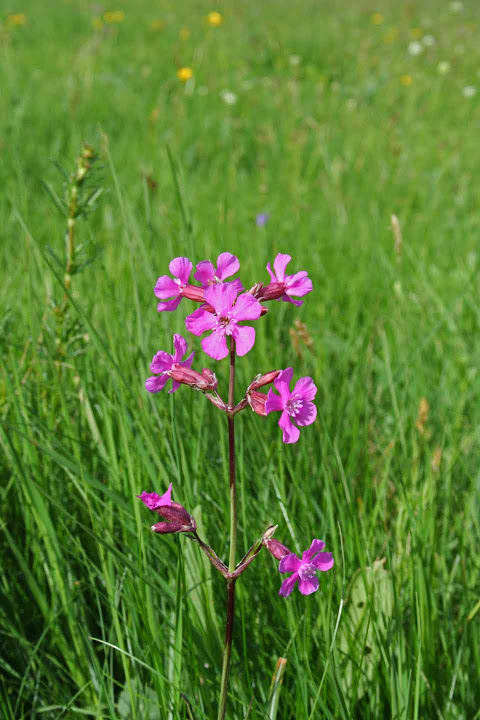 The author of Forgotten beauty chooses to walk to the
village of Umoljani before heading west, but we followed a grassy
track to "Studeni potok", which means Cold creek. This is a small
valley with a meandering stream of clear mountain water. There is
a legend about Studeni potok, saying that once a terrible dragon
came from the Rakitnica canyon. He chased away the villagers of
Umoljani. This dragon had a snake shaped body that still can be
seen nowadays, in the form of the creek. We didn't see any snakes
(or dragons for that matter) but we did see a very nicely
developed ecosystem. Just to give you an impression: next to the
water there were masses of Caltha palustris, Rhinanthus
borbasii, Geum rivale, Lychnis flos-cuculi, Polygonum bistorta
and Trollius europaeus. A little bit further away from the
water we found Lychnis viscaria (see picture), Chamaecytisus
hirsutus (gr.), Scorzonera rosea, Lilium bosniacum, Dactylorhiza
sambucina, Anthyllis vulneraria ssp alpestris and
Euphorbia brittingeri.
The author of Forgotten beauty chooses to walk to the
village of Umoljani before heading west, but we followed a grassy
track to "Studeni potok", which means Cold creek. This is a small
valley with a meandering stream of clear mountain water. There is
a legend about Studeni potok, saying that once a terrible dragon
came from the Rakitnica canyon. He chased away the villagers of
Umoljani. This dragon had a snake shaped body that still can be
seen nowadays, in the form of the creek. We didn't see any snakes
(or dragons for that matter) but we did see a very nicely
developed ecosystem. Just to give you an impression: next to the
water there were masses of Caltha palustris, Rhinanthus
borbasii, Geum rivale, Lychnis flos-cuculi, Polygonum bistorta
and Trollius europaeus. A little bit further away from the
water we found Lychnis viscaria (see picture), Chamaecytisus
hirsutus (gr.), Scorzonera rosea, Lilium bosniacum, Dactylorhiza
sambucina, Anthyllis vulneraria ssp alpestris and
Euphorbia brittingeri.
 At the first specimen of Lilium bosniacum (see picture) we
cheered and were impressed by the beauty of the plant. When we
looked a little bit further, we saw many, many, many more
specimens. The identification of this plant, though easily
recognizable, was somewhat of a puzzle because of changes in
species names. Lilium bosniacum, Lilium albanicum and Lilium
jankae have been regarded as varieties of Lilium
carneolicum for a long time, but based on DNA-analysis they
are now treated as separate species. The species look alike very
much, with yellow sepals, curved strongly and forming a Turk's
cap-shape. The flowers are placed in racemes of 1-6 and can be
used to tell the difference between the species. The sepals of Lilium
jankae have purple spots. The sepals of Lilium bosniacum
are a bit purplish at the base, but do not have distinct spots.
The sepals of Lilium albanicum are almost completely
yellow or orange, but do not have purple spots at all.
At the first specimen of Lilium bosniacum (see picture) we
cheered and were impressed by the beauty of the plant. When we
looked a little bit further, we saw many, many, many more
specimens. The identification of this plant, though easily
recognizable, was somewhat of a puzzle because of changes in
species names. Lilium bosniacum, Lilium albanicum and Lilium
jankae have been regarded as varieties of Lilium
carneolicum for a long time, but based on DNA-analysis they
are now treated as separate species. The species look alike very
much, with yellow sepals, curved strongly and forming a Turk's
cap-shape. The flowers are placed in racemes of 1-6 and can be
used to tell the difference between the species. The sepals of Lilium
jankae have purple spots. The sepals of Lilium bosniacum
are a bit purplish at the base, but do not have distinct spots.
The sepals of Lilium albanicum are almost completely
yellow or orange, but do not have purple spots at all.
 Because the valley of Studeni potok was so beautiful, we decided
to put up our tent to stay there for the night. The next morning
the valley proved to be breathtakingly magnificent in the fragile
light of the upcoming sun. After we packed our belongings into our
backpack, we continued our route, soon to arrive at the top of the
famous Rakitnica gorge. This is said to be one of the most
untouched gorges in Europe, with lots of endemic plant species. We
did not enter the gorge, simply because we didn't have a good map
of the area and were not sure of potential mining activities
during the war. But there was a lot to see at the top of the
ravine as well! In a grassy field we found Alyssum murale,
Scorzonera rosea (see picture), Trifolium montanum,
Veronica austriaca ssp jacquini and Onobrychis montana.
Between the rocks going down steeply we found Helianthemum
nummularium, Ornithogalum oligophyllum, Dianthus carthusianorum
and, from a little distance, Chaerophyllum coloratum.
Because the valley of Studeni potok was so beautiful, we decided
to put up our tent to stay there for the night. The next morning
the valley proved to be breathtakingly magnificent in the fragile
light of the upcoming sun. After we packed our belongings into our
backpack, we continued our route, soon to arrive at the top of the
famous Rakitnica gorge. This is said to be one of the most
untouched gorges in Europe, with lots of endemic plant species. We
did not enter the gorge, simply because we didn't have a good map
of the area and were not sure of potential mining activities
during the war. But there was a lot to see at the top of the
ravine as well! In a grassy field we found Alyssum murale,
Scorzonera rosea (see picture), Trifolium montanum,
Veronica austriaca ssp jacquini and Onobrychis montana.
Between the rocks going down steeply we found Helianthemum
nummularium, Ornithogalum oligophyllum, Dianthus carthusianorum
and, from a little distance, Chaerophyllum coloratum.
 The narrow path soon entered a forest that provided us with a lot
of new plant species. Huge amounts of Iris graminea (see
picture) were present right next to the path. Here we also found Crataegus
calycina, Viburnum lanata, Geranium sanguineum, Hypericum
alpigenum, Paris quadrifolia and Melittis
melissopphyllum. The forest was rather dense, but it
contained also more open grassy areas with Polygala major,
Smyrnium perfoliatum, Trifolium alpestre and Vicia
montenegrina. We climbed a rocky slope where we found Globularia
cordifolia, Campanula trachelium, Onosma stellulata,
Saxifraga paniculata, Muscari commutatum, Bellevalia dubia and
Alyssum montanum.
The narrow path soon entered a forest that provided us with a lot
of new plant species. Huge amounts of Iris graminea (see
picture) were present right next to the path. Here we also found Crataegus
calycina, Viburnum lanata, Geranium sanguineum, Hypericum
alpigenum, Paris quadrifolia and Melittis
melissopphyllum. The forest was rather dense, but it
contained also more open grassy areas with Polygala major,
Smyrnium perfoliatum, Trifolium alpestre and Vicia
montenegrina. We climbed a rocky slope where we found Globularia
cordifolia, Campanula trachelium, Onosma stellulata,
Saxifraga paniculata, Muscari commutatum, Bellevalia dubia and
Alyssum montanum.
 After a while we arrived at Lukomir. According to the many
leaflets published by the Sarajevo tourist information, this is
supposed to be the most remote village in Europe. It may well be
the case, but we noticed that this "remote" village was easily
accessible by car and that both electricity and satellite
television were present. So we didn't try to make contact with the
local traditional villagers, but continued our Botanical Journey
instead. We had planned to walk all the way to the town of Blace
and then to the Neretva valley. So in Lukomir we passed a small
river, climbed a rocky hill and continued to follow a
pre-war path to the west. We found some very beautiful specimens
of Onosma stellulata (see picture) here, as well as Centaurea
montana. The road appeared to have been disused for quite
some time and as soon as we realized that we had entered some sort
of minefield, we turned back to Lukomir and followed a gravel road
northwards instead. We put up our tent somewhere suitable and in
the night we could hear wolves howling in the hills surrounding
us.
After a while we arrived at Lukomir. According to the many
leaflets published by the Sarajevo tourist information, this is
supposed to be the most remote village in Europe. It may well be
the case, but we noticed that this "remote" village was easily
accessible by car and that both electricity and satellite
television were present. So we didn't try to make contact with the
local traditional villagers, but continued our Botanical Journey
instead. We had planned to walk all the way to the town of Blace
and then to the Neretva valley. So in Lukomir we passed a small
river, climbed a rocky hill and continued to follow a
pre-war path to the west. We found some very beautiful specimens
of Onosma stellulata (see picture) here, as well as Centaurea
montana. The road appeared to have been disused for quite
some time and as soon as we realized that we had entered some sort
of minefield, we turned back to Lukomir and followed a gravel road
northwards instead. We put up our tent somewhere suitable and in
the night we could hear wolves howling in the hills surrounding
us.
 The next day we had come up
with another plan and decided to walk towards the town of Konjic.
The gravel path was well used so we didn't have to worry about
mines here (although some sidetracks were closed and signed with
warning messages). The path brought us through several plateaus
rich in lime stone, with Ajuga genevensis, Salvia pratensis and
lots of Helleborus dumetorum. In a chestnut forest we
found Doronicum columnae and Pedicularis
friderici-augusti (see picture). At some locations the snow
had melted just a couple of days ago. There we found species like
Gentiana utriculosa, Ranunculus montanus and both Primula
elatior and Primula veris.
The next day we had come up
with another plan and decided to walk towards the town of Konjic.
The gravel path was well used so we didn't have to worry about
mines here (although some sidetracks were closed and signed with
warning messages). The path brought us through several plateaus
rich in lime stone, with Ajuga genevensis, Salvia pratensis and
lots of Helleborus dumetorum. In a chestnut forest we
found Doronicum columnae and Pedicularis
friderici-augusti (see picture). At some locations the snow
had melted just a couple of days ago. There we found species like
Gentiana utriculosa, Ranunculus montanus and both Primula
elatior and Primula veris.
Our BotanicalJourney ended near the town of Vrdolje, where a car
stopped and offered us a lift all the way to Mostar. The
temperatures had climbed to more than thirty degrees so we gladly
accepted the offer as well as the home-made lemonade. The people
were very friendly, as most people in Bosnia and Herzegovina are!
From Mostar we took a Centrotrans-bus to the town of Tjentište, in
the middle of the Sutjeska National Park. And that is where the
next part of our BotanicalJourney took place.
BotanicalJourney in Sutjeska National Park (Google Map)
(please note: the georeference of this route is not very
accurate, due to the low quality of the satellite image in
GoogleMaps)
 Sutjeska, situated at the border with Montenegro, has been a
National Park since 1962 and covers an area of about 17,500
hectares. It is famous for its World War II history, when Tito
proved to be cleverer than the German army. This occasion is still
remembered by impressive monuments where people come to lay fresh
flowers every day in memory of the great Tito. But Sutjeska also
is one of the most diversified Nature Parks of the Balkan. It
includes the highest peak of Maglić at 2,386 meters and contains
many glacier lakes like Trnovačko Jezero. At lower altitudes you
can find Peručica primeval forest, with impressive more than 60
meters high trees, aged well over 300 years. Skakavac Waterfall is
one of the highest waterfalls in Bosnia and Herzegovina: the water
drops down over more than 75 meters and flows towards the deep and
rugged canyon of Sutjeska River. In Sutjeska you can find bears,
boars, wolves, martens, golden eagles and Greek partridges. The
park's vegetation includes forests, mountain areas, rocks and
meadows. The northwestern hill slopes are covered with coniferous
and beech trees up to an elevation of 1,600 meters. It is said
that 2,600 plant species can be found in Sutjeska, of which many
are endemic.
Sutjeska, situated at the border with Montenegro, has been a
National Park since 1962 and covers an area of about 17,500
hectares. It is famous for its World War II history, when Tito
proved to be cleverer than the German army. This occasion is still
remembered by impressive monuments where people come to lay fresh
flowers every day in memory of the great Tito. But Sutjeska also
is one of the most diversified Nature Parks of the Balkan. It
includes the highest peak of Maglić at 2,386 meters and contains
many glacier lakes like Trnovačko Jezero. At lower altitudes you
can find Peručica primeval forest, with impressive more than 60
meters high trees, aged well over 300 years. Skakavac Waterfall is
one of the highest waterfalls in Bosnia and Herzegovina: the water
drops down over more than 75 meters and flows towards the deep and
rugged canyon of Sutjeska River. In Sutjeska you can find bears,
boars, wolves, martens, golden eagles and Greek partridges. The
park's vegetation includes forests, mountain areas, rocks and
meadows. The northwestern hill slopes are covered with coniferous
and beech trees up to an elevation of 1,600 meters. It is said
that 2,600 plant species can be found in Sutjeska, of which many
are endemic.
The village of Tjentište is not more than a couple of houses with
a petrol station. There are also a police office, a small shop, a
swimming pool and a hotel with a camp site. Don't expect too much
of the camp site, but if you don't care for a luxurious stay, it
is pretty OK, I guess. From the village Sutjeska National Park can
be entered by following the small road opposite the petrol station
(this is where the small shop is as well). When you are by car you
can drive up to a parking space at Prijevor (altitude about 1,700
meters) or an area at about 5 kilometers after Dragoš Selo (at
about 1,600 meters). In our case we didn't have a car, but a
member of the hotel staff kindly drove us up hill to Prijevor. The
view over the mountain tops of Sutjeska was impressive.
 So the second part of our BotanicalJourney started at an altitude
of 1,700m. The first goal of this Journey was the Volujak-range,
of which the summit has a height of 2,336m. The route towards
Volujak was clearly marked with red-and-white paint marks on trees
and stones, so orientation was not difficult at all. The
vegetation at the start of the trip at Prijevor was already
somewhat sub-alpine and rich in orchids: mainly Dactylorhiza
majalis and Gymnadenia conopsea (see picture).
There were also many specimens of Lilium bosniacum present
there.
So the second part of our BotanicalJourney started at an altitude
of 1,700m. The first goal of this Journey was the Volujak-range,
of which the summit has a height of 2,336m. The route towards
Volujak was clearly marked with red-and-white paint marks on trees
and stones, so orientation was not difficult at all. The
vegetation at the start of the trip at Prijevor was already
somewhat sub-alpine and rich in orchids: mainly Dactylorhiza
majalis and Gymnadenia conopsea (see picture).
There were also many specimens of Lilium bosniacum present
there.
 Soon the path entered the country of Montenegro, or Crna Gora. The
border was marked by a small wooden sign. The forest was very
dense at some places and rich in mosquito's. We found Euphorbia
carniolica and Agrimonia agrimonoides here. In a
small valley with a little lake called Suva Jezerina there was a
small path going down towards Tjentište, following a small stream.
Though it looked interesting enough we didn't follow it, but
continued to follow the path up hill instead. After a while we
reached Trnovačo Jezero. This is a glacier lake at an elevation of
1,513 meters, surrounded by steep slopes from the Maglić and
Volujak mountain ranges. We were the only people present there so
the silence and force of natural beauty was astonishing. The lake
was surrounded by Dactylorhiza majalis and Trollius
europaeus (see picture). Many dragonflies were hovering
above the lake and we could see some fish in the crystal clear
water.
Soon the path entered the country of Montenegro, or Crna Gora. The
border was marked by a small wooden sign. The forest was very
dense at some places and rich in mosquito's. We found Euphorbia
carniolica and Agrimonia agrimonoides here. In a
small valley with a little lake called Suva Jezerina there was a
small path going down towards Tjentište, following a small stream.
Though it looked interesting enough we didn't follow it, but
continued to follow the path up hill instead. After a while we
reached Trnovačo Jezero. This is a glacier lake at an elevation of
1,513 meters, surrounded by steep slopes from the Maglić and
Volujak mountain ranges. We were the only people present there so
the silence and force of natural beauty was astonishing. The lake
was surrounded by Dactylorhiza majalis and Trollius
europaeus (see picture). Many dragonflies were hovering
above the lake and we could see some fish in the crystal clear
water.
 From the lake we followed a
path southeast, climbed a grassy slope, passed some houses and
went up to the slopes of the Volujak range. In the rocky crevices
we found Edraianthus serpyllifolius (see picture) and Silene
pusilla. By the way: if you should choose to follow this
path in the summer, be aware that the small stream near the houses
is the last place where you can collect water. There are no
streams higher up in the mountains, unless you manage to find some
recently melted snow.
From the lake we followed a
path southeast, climbed a grassy slope, passed some houses and
went up to the slopes of the Volujak range. In the rocky crevices
we found Edraianthus serpyllifolius (see picture) and Silene
pusilla. By the way: if you should choose to follow this
path in the summer, be aware that the small stream near the houses
is the last place where you can collect water. There are no
streams higher up in the mountains, unless you manage to find some
recently melted snow.
 In our case the visit to Sutjeska took place quite early in the
season so there were many places where the snow had melted only a
couple of days ago. These areas, where the grass was still brown
from the snow that had been on top of it, were rich in Crocus
vernus, Soldanella alpina and Ranunculus montanus. A
little bit higher up the slopes we found Gentiana acaulis,
Dactylorhiza sambucina and many, many, many Dryas
octopetala. The latter was quite abundant on the Volujak
slopes. Anthyllis vulneraria ssp alpestris was present at
many rocks as well and we also found Pedicularis orthantha.
The yellow flowers of Viola zoysii (see picture) were
clearly visible throughout the area.
In our case the visit to Sutjeska took place quite early in the
season so there were many places where the snow had melted only a
couple of days ago. These areas, where the grass was still brown
from the snow that had been on top of it, were rich in Crocus
vernus, Soldanella alpina and Ranunculus montanus. A
little bit higher up the slopes we found Gentiana acaulis,
Dactylorhiza sambucina and many, many, many Dryas
octopetala. The latter was quite abundant on the Volujak
slopes. Anthyllis vulneraria ssp alpestris was present at
many rocks as well and we also found Pedicularis orthantha.
The yellow flowers of Viola zoysii (see picture) were
clearly visible throughout the area.
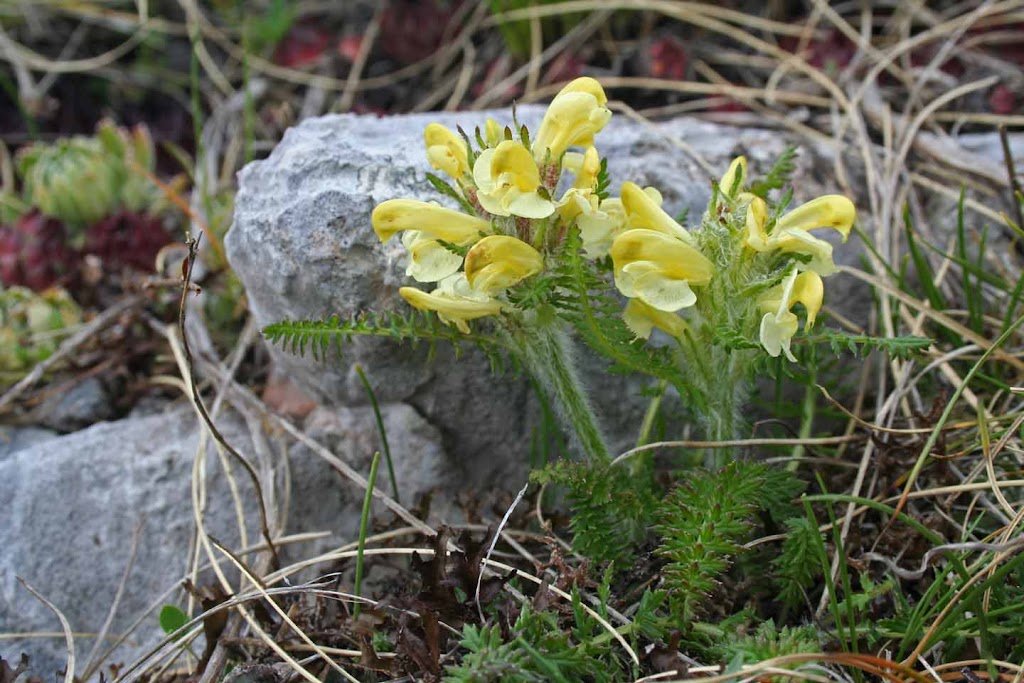 The vegetation became more
alpine as we climbed the hill. Salix retusa, Anemone
narcissiflora, Astragalus depressus and Muscari
botryoides were some of the species to prove that. At one
location we found a Pedicularis species I could not
identify at first. I took several pictures, which made it possible
to identify the plant afterwards by using Flora Euopaea. I believe
it was Pedicularis brachyodonta (see picture). The
finding of Geranium pretense was somewhat surprising to
me, because I didn't know it could be found at such high
altitudes.
The vegetation became more
alpine as we climbed the hill. Salix retusa, Anemone
narcissiflora, Astragalus depressus and Muscari
botryoides were some of the species to prove that. At one
location we found a Pedicularis species I could not
identify at first. I took several pictures, which made it possible
to identify the plant afterwards by using Flora Euopaea. I believe
it was Pedicularis brachyodonta (see picture). The
finding of Geranium pretense was somewhat surprising to
me, because I didn't know it could be found at such high
altitudes.
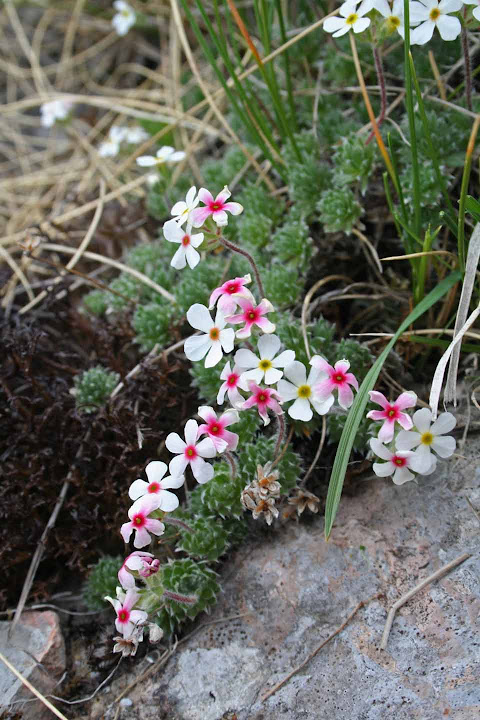 The path continued to go up hill, all the way to the saddle in
between the peaks of Volujak and Trnovački Durmitor. We followed
the path as far as we could, but in the end the Volujak summit
proved to be inaccessible for us. We didn't have the right
equipment to climb the snow-covered slopes at the last couple of
hundreds of meters, so we ended our walk at an altitude of about
2,100 meters. The view was spectacular and the area was rich in
plant species: Silene acaulis, Androsace villosa (see
picture), Euphorbia capitulata and Aster
bellidiastrum were some of them. There was one Euphorbia
species that I could not identify. Maybe it was Euphorbia
montenegrina, but I am not sure of that. I took a picture
of it, so maybe I am able to confirm or reject this identification
later. We descended the hills and put up our tent somewhere at a
more or less horizontal spot.
The path continued to go up hill, all the way to the saddle in
between the peaks of Volujak and Trnovački Durmitor. We followed
the path as far as we could, but in the end the Volujak summit
proved to be inaccessible for us. We didn't have the right
equipment to climb the snow-covered slopes at the last couple of
hundreds of meters, so we ended our walk at an altitude of about
2,100 meters. The view was spectacular and the area was rich in
plant species: Silene acaulis, Androsace villosa (see
picture), Euphorbia capitulata and Aster
bellidiastrum were some of them. There was one Euphorbia
species that I could not identify. Maybe it was Euphorbia
montenegrina, but I am not sure of that. I took a picture
of it, so maybe I am able to confirm or reject this identification
later. We descended the hills and put up our tent somewhere at a
more or less horizontal spot.
 The next day we went back to Trnovačko Jezero. From there we
climbed the steep slope to the northwest, heading for the Maglić,
which is the highest mountain of Bosnia and Herzegovina. Its
altitude is 2,386 meters. The ascend was heavy: from Trnovačko
Jezero we had to climb about 700 meters in a horizontal distance
of about 1,500 meters. While scrambling over the rocks, we found
many specimens of Saxifraga marginata (see picture). Some
parts of the path were not visible anymore because of small slides
of loose rocks and stones. Orientation was not difficult however
(we just had to go up, up, up) and finally we reached the summit
ridge at an altitude of about 2,200 meters. The ridge was
partially covered with Pinus mugo.
The next day we went back to Trnovačko Jezero. From there we
climbed the steep slope to the northwest, heading for the Maglić,
which is the highest mountain of Bosnia and Herzegovina. Its
altitude is 2,386 meters. The ascend was heavy: from Trnovačko
Jezero we had to climb about 700 meters in a horizontal distance
of about 1,500 meters. While scrambling over the rocks, we found
many specimens of Saxifraga marginata (see picture). Some
parts of the path were not visible anymore because of small slides
of loose rocks and stones. Orientation was not difficult however
(we just had to go up, up, up) and finally we reached the summit
ridge at an altitude of about 2,200 meters. The ridge was
partially covered with Pinus mugo.
 From there on the walk was easier and far less steep. Many alpine
plant species were present, like Nigritella nigra, Silene
acaulis and Gentiana acaulis (see picture). The top
of the Maglić was easy accessible and quite busy with other
visitors (I believed them to be Czechs because they said "Ahoy" to
each other, which was very funny because in the Netherlands this
word is only used by sailors like Popeye). Just a couple of
hundreds of meters below the summit of Maglić we followed a path
going (north)west. At first it was a very steep way down. Many
parts of this slope were less exposed to the sun, so there were
several new plant species to be found. Cerinthe glabra was
one of the most obvious, but we also found Muscari botryoides,
Scilla bifolia and Polystichum lonchitis.
From there on the walk was easier and far less steep. Many alpine
plant species were present, like Nigritella nigra, Silene
acaulis and Gentiana acaulis (see picture). The top
of the Maglić was easy accessible and quite busy with other
visitors (I believed them to be Czechs because they said "Ahoy" to
each other, which was very funny because in the Netherlands this
word is only used by sailors like Popeye). Just a couple of
hundreds of meters below the summit of Maglić we followed a path
going (north)west. At first it was a very steep way down. Many
parts of this slope were less exposed to the sun, so there were
several new plant species to be found. Cerinthe glabra was
one of the most obvious, but we also found Muscari botryoides,
Scilla bifolia and Polystichum lonchitis.
 After a while we reached a landscape with many dolines. This area
consisted of limestone and there were many grassy fields
containing Nigritella nigra, Dactylorhiza sambucina (both
purple and yellow), Silene sendtneri and Lilium
bosniacum. We also found many specimens of the biggest Botrychium
lunaria we have ever seen (see picture)!
After a while we reached a landscape with many dolines. This area
consisted of limestone and there were many grassy fields
containing Nigritella nigra, Dactylorhiza sambucina (both
purple and yellow), Silene sendtneri and Lilium
bosniacum. We also found many specimens of the biggest Botrychium
lunaria we have ever seen (see picture)!
 Later we entered the famous primeval forest of Perućica. There
were trees of over 300 years old, with an unimaginable height
(more than 60 meters). Plant species were spectacular as well: Cephalanthera
longifolia, Cephalanthera rubra, Convallaria majalis (see
picture), Melittis melissophyllum, Phyteuma orbiculare,
Euphorbia amygdaloides, Aquilegia vulgaris, Geranium phaeum
and Lunaria rediviva are some of the species we found. The
smell of Allium ursinum was penetrating the whole forest.
On exposed, rocky places we found Saxifraga paniculata and
in a field near some sort of Tito-memorial there were lots of Tragopogon
pratensis and Verbascum glabratum. We followed the
road all the way back to Tjentište, where our BotanicalJourney
ended.
Later we entered the famous primeval forest of Perućica. There
were trees of over 300 years old, with an unimaginable height
(more than 60 meters). Plant species were spectacular as well: Cephalanthera
longifolia, Cephalanthera rubra, Convallaria majalis (see
picture), Melittis melissophyllum, Phyteuma orbiculare,
Euphorbia amygdaloides, Aquilegia vulgaris, Geranium phaeum
and Lunaria rediviva are some of the species we found. The
smell of Allium ursinum was penetrating the whole forest.
On exposed, rocky places we found Saxifraga paniculata and
in a field near some sort of Tito-memorial there were lots of Tragopogon
pratensis and Verbascum glabratum. We followed the
road all the way back to Tjentište, where our BotanicalJourney
ended.
So this is where my report on a BotanicalJourney in Bosnia and
Herzegovina ends. As you probably have noticed, I am enthusiastic
about the country, the mountains, the plant species and the
people. I really can recommend everybody looking for overwhelming
nature, solitude and wildlife magnificence to visit the area.
I will conclude this BotanicalJourney by presenting a full list of
the wild plant species I have recorded in Bjelašnica (122 species)
and in Sutjeska (162 species).
Full list of observed species in Bjelašnica (Google Map)
Achillea millefolium
Acinos alpinus
Adenostyles alliariae
Ajuga genevensis
Ajuga reptans
Alyssum montanum
Alyssum murale
Anemone narcissiflora
Anemone nemorosa
Antennaria carpatica
Anthyllis vulneraria ssp alpestris
Armeria canescens
Asplenium fissum
Bellevalia dubia
Botrychium lunaria
Caltha palustris
Campanula patula
Campanula rotundifolia
Campanula trachelium
Carlina acaulis
Centaurea montana
Chaerophyllum coloratum
Chamaecytisus hirsutus cf.
Cicerbita alpina
Coeloglossum viride
Crataegus calycina
Dactylorhiza sambucina
Dianthus carthusianorum
Dianthus sylvestris
Diphasium alpinum
Doronicum columnae
Echium vulgare
Euphorbia brittingeri
Euphorbia myrsinites
Faga vescaria
Fragaria viridis
Fritillaria messanensis
Galeobdolon luteum
Genista sylvestris
Gentiana acaulis
Gentiana asclepiadea
Gentiana utriculosa
Geranium sanguineum
Geum montanum
Geum rivale
Globularia cordifolia
Gypsophila repens
Helianthemum nummularium
Helleborus dumetorum
Hippocrepis comosa
Hyoscyamus niger
Hypericum alpigenum
Iris graminea
Jasione orbiculata
Juniperus communis
Lilium bosniacum
Linum capitatum
Lychnis flos-cuculi
Lychnis viscaria
Melittis melissophyllum
Minuartia graminifolia
Muscari commutatum
Myosotis alpestris
Myosotis scorpioides
Onobrychis montana
Onosma stellulata
Ophioglossum vulgatum
Ornithogalum oligophyllum
Paris quadrifolia
Pedicularis friderici-augusti
Pedicularis verticillata
Phyteuma orbiculare
Pinus mugo
Plantago major
Polygala major
Polygonum bistorta
Potentilla crantzii
Potentilla montenegrina
Potentilla pusilla
Primula elatior
Primula veris
Ranunculus montanus
Ranunculus thora ?
Rhinanthus borbasii
Rhodiola rosea
Rorippa sylvestris
Rumex alpinus
Rumex scutatus
Salvia pratensis
Sanguisorba officinalis
Saxifraga paniculata
Saxifraga stellaris
Scorzonera rosea
Sedum reflexum
Selaginella denticulata
Sempervivum zeleborii
Senecio rupestris
Silene alpestris
Silene nutans
Silene sendtneri
Silene vulgaris
Symphytum tuberosum
Smyrnium perfoliatum
Stachys annua
Thesium alpinum
Trifolium alpestre
Trifolium montanum
Trollius europaeus
Tussilago farfara
Urtica dioica
Valeriana montana
Valeriana officinalis
Veratrum album
Verbascum spec
Veronica austriaca ssp jacquini
Viburnum lanata
Vicia cracca
Vicia montenegrina
Viola biflora
Viola calcarata
Viola odorata
Viola riviniana
Full list of observed species in Sutjeska National Park (Google Map)
Achillea abrotanoides
Achillea millefolium
Acinos alpinus
Aconitum variegatum
Adenostyles alliariae
Adiantum capillus-veneris
Agrimonia agrimonoides
Agrostemma githago
Allium ursinum
Anacamptis pyramidalis
Androsace villosa
Anemone narcissiflora
Anemone nemorosa
Anogramma leptophylla
Antennaria dioica
Anthericum ramosum
Anthyllis vulneraria ssp alpestris
Aquilegia vulgaris
Armeria canescens
Aruncus dioicus
Asarum europaeum
Asphodelus albus
Asplenium fissum
Astagalus depressus
Aster bellidiastrum
Astragalus depressus
Astragalus sirinicus
Athyrium filix femina
Botrychium lunaria
Caltha palustris
Edraianthus serpyllifolius
Campanula latifolia
Campanula patula
Campanula rotundifolia
Campanula trachelium
Carlina acaulis
Cephalanthera longifolia
Cephalanthera rubra
Cerinthe glabra
Cicerbita alpina
Coeloglossum viride
Convallaria majalis
Cortoneaster integerrima
Corylus avellana
Crocus vernus
Dactylorhiza incarnata
Dactylorhiza majalis
Dactylorhiza sambucina
Dianthus carthusianorum
Dianthus sylvestris
Dryas octopetala
Erigeron polymorphus
Euphorbia amygdaloides
Euphorbia capitulata
Euphorbia carniolica
Faga vescaria
Fagus sylvatica
Fritillaria messanensis
Galeobdolon luteum
Galium mollugo
Gentiana acaulis
Gentiana asclepiadea
Gentiana punctata
Gentiana utriculosa
Geranium phaeum
Geranium tuberosum
Geum montanum
Gymnadenia conopsea
Gypsophila repens
Helianthemum nummularium
Helleborus dumetorum
Hieracium aurantiacum
Homogyne alpina
Hypericum alpinum
Juniperus communis
Lactuca perennis
Lamiastrum galeobdolon
Lamium album
Lathyrus latifolius
Lilium bosniacum
Linum austriacum
Linum capitatum
Linum flavum
Listera ovata
Lonicera caerulea
Lunaria rediviva
Luzula sylvatica
Lychnis viscaria
Lysimachia nemorum
Lysimachia nummularia
Maianthemum bifolium
Melittis melissophyllum
Muscari botryoides
Myosotis alpestris
Myosotis laxa
Narcissus poeticus
Nigritella nigra
Noccaea praecox
Orobanche alba
Oxyria digyna
Pedicularis brachyodonta
Pedicularis friderici-augusti
Pedicularis orthantha
Pedicularis verticillata
Phyteuma orbiculare
Pinus mugo
Plantago argentea
Plantago coronopus
Plantago reniformis
Polygonatum verticillatum
Polygonum bistorta
Polygonum viviparum
Polystichum lonchitis
Potentilla crantzii
Potentilla montenegrina
Primula elatior
Pteridium aquilinum
Pulmonaria officinalis
Quercus petraea
Ranunculus montanus
Rumex alpinus
Rumex nivalis
Rumex scutatus
Salix retusa
Salvia pratensis
Sambucus nigra
Sanguisorba officinalis
Saxifraga caesia
Saxifraga marginata
Saxifraga paniculata
Saxifraga stellaris
Scilla bifolia
Scrophularia nodosa
Sedum album
Sedum alpestre
Selaginella denticulata
Senecio rupestris
Silene acaulis
Silene alpestris
Silene nutans
Silene pusilla
Silene sendtneri
Silene vulgaris
Soldanella alpina
Sorbus aucuparia
Stellaria holostea
Stellaria nemorum
Thesium alpinum
Tragopogon pratensis
Trollius europaeus
Tussilago farfara
Urtica dioica
Vaccinium myrtillus
Vaccinium vitis-idaea
Valeriana montana
Valeriana officinalis
Veratrum album
Verbascum glabratum ?
Vicia cracca
Viola odorata
Viola riviniana
Viola zoysii